

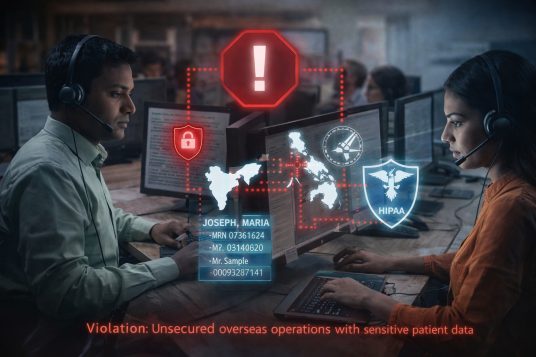
Many healthcare leaders look for ways to reduce high operational costs. Consequently, they often hire overseas subcontractors for data tasks and administrative processing. Using overseas resources creates significant risks for modern organizations. This practice might seem convenient due to cheaper labor. However, it often leads to higher liabilities under strict HIPAA and state requirements.
What exactly is an unlicensed company in the healthcare context? Simply put, it is an entity performing regulated functions without state approval. In Florida, specific tasks like claims adjudication require a Certificate of Authority. An unlicensed company lacks this official credential. Therefore, state regulators cannot inspect their books or verify their stability. They operate effectively as “ghosts” beyond the legal reach of our authorities.
State law and federal HIPAA requirements offer different layers of protection. Florida law focuses on the “competent and trustworthy” nature of administrators. If you use an unlicensed entity, you violate state insurance codes. Federal HIPAA rules require robust Business Associate Agreements (BAAs). However, HIPAA does not strictly ban offshoring. Instead, it places 100% of the legal liability on the U.S. entity.
The location of your workers matters immensely for legal oversight. For example, consider the difference between resources in India and Puerto Rico. India is a foreign nation with a distinct legal system. US regulators cannot easily reach across the ocean to enforce laws. In contrast, Puerto Rico is a United States territory. Therefore, it follows all US federal laws and HIPAA regulations.
Working with teams in Puerto Rico offers a safer domestic alternative. Federal courts have clear jurisdiction over activities on the island. This oversight provides a level of security that foreign nations cannot match. Additionally, communication often remains smoother within a single national framework. You protect your business when you keep data within the reach of US law.
The recent Mirra Health case highlights these dangers clearly. Mirra shared sensitive data of 23,119 Florida members with unlicensed companies in India. Consequently, the Florida Insurance Commissioner suspended their certificate of authority immediately. This suspension happened because the company acted in a “reckless” manner. They moved data outside the reach of state oversight without prior written permission.
A new trend is emerging among major US health plans. Many companies are now changing their contracts to avoid overseas resources entirely. These organizations recognize the “vicarious liability” created by offshoring. They are adding strict “No Offshoring” clauses to protect their reputations. They want to avoid the “reckless” label recently applied in the Mirra case.
The root of the problem is often a lack of transparency. Many companies fail to map their data flow accurately. They do not realize where their information actually travels. Furthermore, some firms skip getting prior written approval from their clients. This oversight creates a massive gap in accountability and safety. You carry all the financial and legal risk for their mistakes.
Taino Consultants understands these complex administrative mechanics. We can evaluate every situation and come up with personalized recommendations. Our team bridges the gap between cost-efficiency and regulatory safety. You deserve a partner who knows the civilian and military landscapes of compliance.
EPI Compliance provides the tools you need for total visibility. We help you create the network maps required for the 2026 HIPAA updates. Managing your program actively prevents reckless exposure of sensitive patient records. Consequently, your organization remains trustworthy and secure in a changing market.
It is up to us to change the variables in our business models. We must prioritize the safety of our patients above all else. By choosing the right partners, we take care of our local communities. Let’s build a healthcare system that is both efficient and legally sound.
Take control now: review, refresh, and actively manage your program. For quick, practical guidance, see EPI Compliance webcasts (Watch on YouTube).