

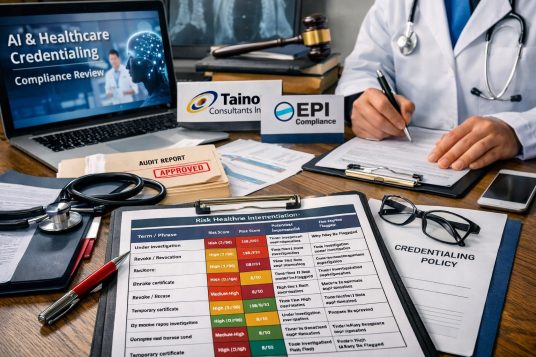
AI Context in Healthcare is the issue many teams now face every day. Healthcare groups want faster work, but they also need safe decisions. AI can help with both goals. However, AI can also create risk when it reads words without a legal or clinical context.
This blog merges the attached draft ideas into one practical guide for healthcare professionals. The goal is simple. You should leave with a clear action plan. That plan should strengthen defensibility, reduce audit exposure, and align compliance execution across your organization.
Healthcare leaders now use AI for credentialing, screening, documentation review, and risk scoring. These tools can save time. They can also catch missing records. Still, the tools often miss meaning. They can treat a lawful phrase as a warning sign.
A strong example comes from Florida and the Area of Critical Need doctor pathway. In that process, a temporary certificate can support care access in underserved areas. Yet some AI tools may label the same phrase as a provider risk. That mismatch can hurt doctors, delay care, and create unfair decisions.
To manage this shift, healthcare teams need human review, better record language, and clear checkpoints. They also need trusted support. Taino Consultants and EPI Compliance can help teams build these controls in a practical way.
For legal and compliance reference, review Florida Statute 458.315, the HHS HIPAA Security Rule summary, and the NIST AI Risk Management Framework.
Why AI can help and why AI can fail
AI can read large files fast. It can compare records and spot gaps. It can also support staff who handle credentialing and compliance. This potential matters because healthcare teams work under constant time pressure.
At the same time, AI does not understand law, intent, or local practice realities. AI sees patterns. It does not understand why a law uses a certain phrase. Because of that, AI may flag a normal term as a threat.
This problem grows when data is incomplete. A missing note can look like a hidden issue. An old address can look like a mismatch. A short phrase can look like misconduct. Then an automated score may push a bad decision.
Therefore, organizations must treat AI as a support tool. They should not treat it as the final judge. Human review is the checkpoint that keeps errors from becoming harm.
Area of Critical Need doctors and the AI context gap
The Area of Critical Need pathway shows the problem clearly. Florida law allows a temporary certificate for practice in areas of critical need. The law supports access to care in underserved communities. This pathway is legal and structured.
Unfortunately, many AI screening models flag the words in this statute as red flags. The following table shows how words found directly within the text of 458.315 are being misinterpreted as Provider Risk signals:
Before you review the table, keep this point in mind. These words are not bad by themselves. They become risky when AI reads them without context.
|
Term / Phrase |
Risk Score |
Potential AI Interpretation |
Why It May Be Flagged |
|
Under investigation |
High (10/10) |
Possible unresolved disciplinary, legal, or professional issue |
Strong adverse-action signal; often auto-escalated |
|
Revoke / Revocation |
High (10/10) |
License/certificate subject to removal |
High-severity enforcement language |
|
Violation |
High (9/10) |
Noncompliance with statute/rule |
Suggests regulatory breach or misconduct risk |
|
Practice privileges have been denied |
High (9/10) |
Prior denial of hospital/institutional privileges |
Major credentialing trigger requiring explanation |
|
Denial / denied (application denial) |
High (8/10) |
Prior adverse licensure/credentialing outcome |
AI may infer prior concerns even if administrative |
|
Temporary certificate |
Medium-High (8/10) |
Limited/conditional licensure pathway |
May be read as non-standard or restricted authority |
|
No written regular examination |
Medium-High (7/10) |
Alternate competency route vs standard exam |
Can trigger equivalency verification review |
|
Abbreviated oral examination |
Medium (6/10) |
Modified/abbreviated evaluation process |
May be treated as reduced vetting rigor |
|
Oral examination (alternate pathway context) |
Medium (5/10) |
Nontraditional licensure assessment pathway |
Usually not adverse, but prompts manual review |
|
Correctional facility |
Medium (5/10) |
Higher-risk practice environment |
Associated with complex populations/security concerns |
|
Health professional shortage areas |
Medium (4/10) |
Staffing-constrained clinical environment |
Signals operational strain, not misconduct |
|
Areas of critical need |
Medium (4/10) |
Underserved or high-need practice setting |
Risk signal is environmental/contextual |
|
Volunteer, uncompensated care |
Low-Medium (3/10) |
Care outside standard compensated employment setting |
Underwriters may ask about coverage scope |
|
Waived (fees waived) |
Low (2/10) |
Administrative exception |
Usually neutral, but ‘exception’ language may be tagged |
|
Indigents / indigent care |
Low (2/10) |
Safety-net population indicator |
More a practice-context signal than a provider risk |
|
Low-income Floridians |
Low (2/10) |
Social/financial complexity of patient population |
Contextual underwriting signal, not adverse action |
After the table, the key takeaway is simple. AI scores should trigger review, not final action. When teams add context notes, they reduce false flags and protect fair decisions.
Now imagine a physician who serves a rural clinic under this pathway. The doctor applies for malpractice coverage. A screening tool flags the file. The underwriter sees a high risk score. The file moves to manual review late, or the file gets denied too quickly. The doctor loses time, income, and patient access.
A similar issue can happen during credentialing. A hospital team may rely on an automated summary. The summary highlights risk words without context. The file gets delayed. The clinic stays short staffed. Patients wait longer for visits. This is how an AI error becomes an operational problem.
The lesson is direct. Context must travel with the record. If your file contains statutory terms, add a short note that explains the legal meaning. That step can prevent avoidable flags and unfair adverse actions.
Examples that healthcare teams can use
Example one involves malpractice underwriting. A file includes the phrase temporary certificate. The system assigns a high score. The team then adds a context note that cites Florida ACN law. The underwriter now sees a legal pathway, not a hidden risk. The file moves forward faster.
Example two involves hospital credentialing. A physician’s file includes a legal phrase from a state rule. The credentialing team uses an AI summary first. The summary sounds negative. A trained reviewer checks the source text and adds a plain language explanation. The committee receives a clean summary and approves the file on time.
Example three involves compliance audits. An organization uses AI to review policy files and provider records. AI finds mismatched dates and missing training documents. The compliance team fixes those gaps, updates records, and logs the changes. Later, the organization can show a clear audit trail.
Example four involves workforce planning. A rural clinic struggles to recruit providers. Leaders use AI tools to organize candidate documents. They also use a manual checklist for license context and statutory pathways. This combined process saves time and protects accuracy.
Focused action framework for defensibility and audit readiness
Start by mapping where AI touches decisions. Look at credentialing, underwriting support, provider onboarding, and compliance review. If a tool affects status or access, mark it as a high review area.
Next, clean your records. Update dates, specialties, addresses, and status notes. Then remove duplicate files. Clear records reduce AI confusion and help staff trust what they see.
Then, add context labels to sensitive terms. Use short labels such as statutory pathway, no board discipline, or administrative condition only. These labels help both humans and AI read the file correctly.
After that, set mandatory human checkpoints. A person must review any file with a high risk score. A person must also review any file with legal terms, restrictions, or investigation wording. This rule improves defensibility right away.
Now build a simple governance process. Decide which AI uses are allowed. Decide which uses need legal or compliance review. Keep an audit log of changes, overrides, and final decisions.
Also, train the workforce on plain language documentation. Staff should write notes that explain what happened and why. Short, clear notes reduce misinterpretation and support better compliance execution.
Finally, test the process each quarter. Review false flags, delays, and override rates. Then adjust your labels, checklists, and training. This loop helps you improve without slowing the team.
AI potential for the future with the right checkpoints
AI still has strong long-term value in healthcare. It can reduce manual tasks and support faster review. It can also help leaders spot trends before risks grow.
The future depends on implementation. Teams need clean data, clear policy rules, and human checkpoints. They also need a review culture that welcomes corrections. These steps make AI safer and more useful.
When healthcare organizations use AI this way, they protect patients and providers. They also improve speed, fairness, and trust. That is the right path forward.
How Taino Consultants and EPI Compliance can support this work
Taino Consultants can help your organization review workflows, record language, and compliance controls. Their services support stronger operations and clearer documentation. Visit Taino Consultants or their compliance services page for more information.
EPI Compliance can support training, policies, forms, and ongoing compliance execution. This support helps teams build consistency and improve audit readiness. Visit EPI Compliance to review tools and program options.
Together, these resources can help healthcare teams use AI with care. The goal is not to avoid technology. The goal is to use technology with clear rules and strong human review.